Pathway diagram maker for cell signaling
Describe the components and relationships in your cell signaling diagram. Abfig turns your brief into an illustrated draft for you to check, revise and export.
01 / Your starting point
What’s the story?
0 / 3000
Output optionsGeneral (choose ratio) · Auto · Single · 1K · Web preview
Up to 1 free generation trial per browser, with no daily refill. Sign in to save your result; downloading new artwork requires paid access.
Paid access unlocks watermark-free downloads for retained originals and journal-sized exports.
02 / Your visual draft
Sample image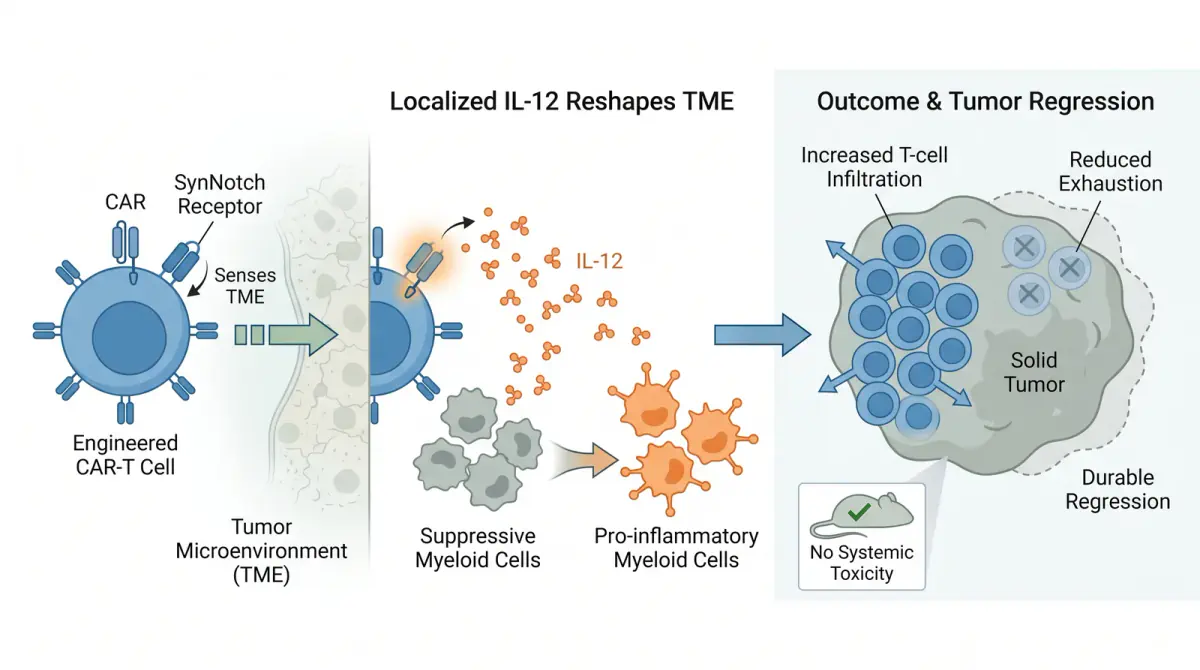
See the kind of story you can build
Your generated figure will replace this example while your abstract and output choices stay in place.
Review every scientific relationship and label, then check your target journal’s current AI-image policy.
An example to inspect and adapt
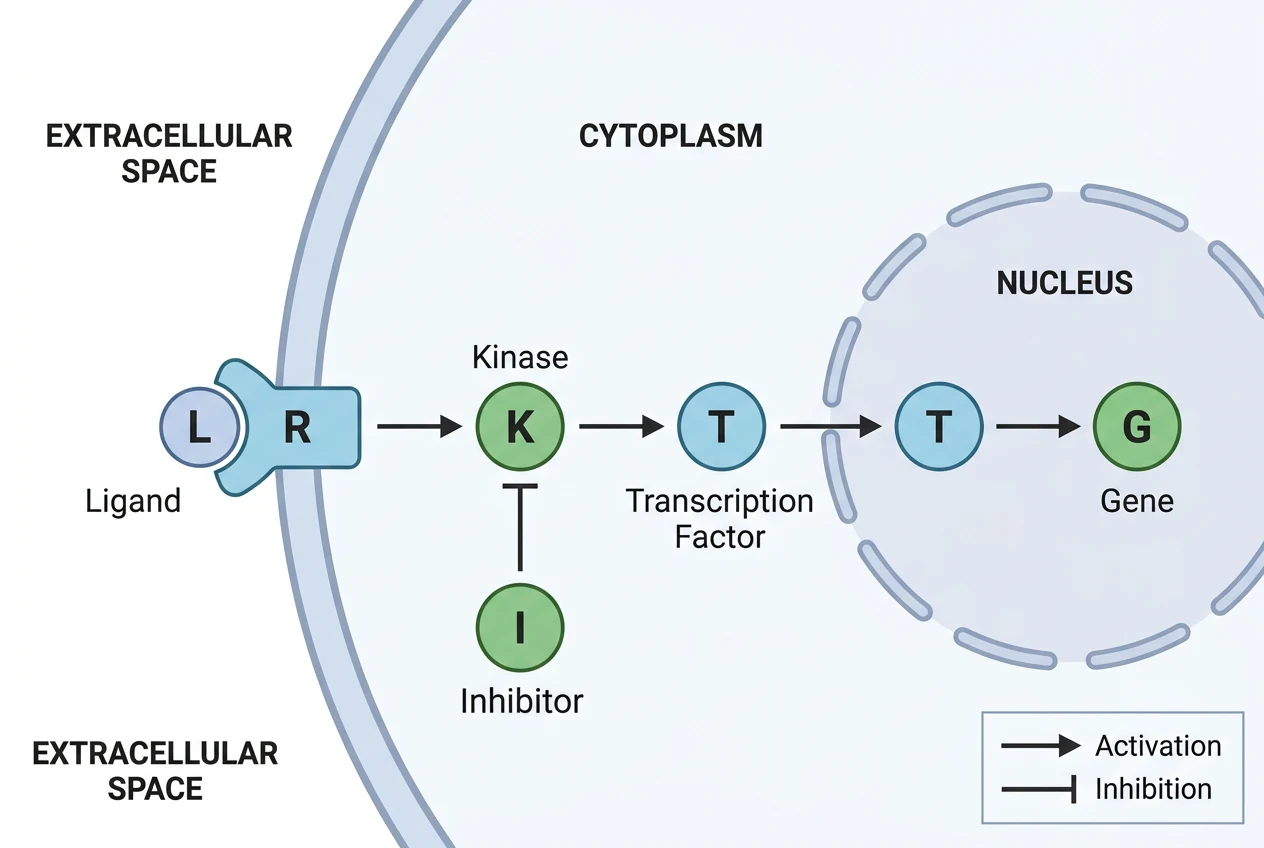
Review of this result: the six components and the inhibitor bar at K are present. The requested cell membrane label is missing and the extracellular label is repeated. Add or correct labels before using a draft; the example does not establish biological accuracy.
Describe the diagram
Draw a simplified, fictional cell signaling pathway diagram. A ligand L outside the cell activates receptor R in the cell membrane. R activates kinase K in the cytoplasm. K activates transcription factor T, which enters the nucleus and activates gene G. An inhibitor I in the cytoplasm inhibits K: show that edge ending in a blunt bar at K, not an activation arrow. Label L, R, K, T, G and I exactly. Label the extracellular space, cell membrane, cytoplasm and nucleus. Include a small legend: arrow means activation; blunt bar means inhibition. Do not add other components or experimental results. This is a fictional teaching example, not a real biological pathway.
What to include in your brief
List the components and compartments
Name the ligand, receptor, intermediate molecules and downstream target that matter to your explanation. Specify what belongs outside the cell, at the membrane, in the cytoplasm or in the nucleus.
Write each relationship explicitly
For a signaling pathway diagram, A activates B is different from B activates A. Spell out activation and inhibition separately, and identify indirect or uncertain relationships in your brief.
Keep the mechanism focused
Start with one cascade or mechanism-of-action branch. A dense network with many crossing edges is harder to generate and inspect. Abfig does not retrieve or validate pathway database records.
Check the draft before using it
- Compare every component name and compartment with your source material. Short labels can still be misspelled or misplaced.
- Check the direction and endpoint of each activation arrow and inhibition bar. Do not infer a biological relationship from the generated image.
- Remove invented components and claims. A pathway illustration is a conceptual draft, not evidence of an experiment or a verified biological model.
Choose a diagram for your research task
Continue working on your figure
Questions about this tool
- Can I draw a biological pathway or mechanism-of-action diagram?
- You can describe a focused biological mechanism and ask for an illustrated draft. This page is designed around cell signaling, not automatically balanced biochemical reactions, chemical structures or pathway database exports.
- Are activation and inhibition arrows guaranteed to be correct?
- No. Explicit relationships help guide the model, but you must compare every connection with your source. Refine or regenerate a draft when an arrow, label or compartment is wrong.
- What can I export or edit?
- Abfig supports RGB PNG and TIFF. Free previews have size and watermark limits; available paid exports depend on your entitlement. Refine redraws the image and selected-area editing changes a region; neither provides editable vector objects.